

You see a base salary. But the real price tag for a new office team member is much higher. That $45,000 yearly wage can balloon to over $71,200 when you account for taxes, benefits, training, and management time.
For HVAC, plumbing, and electrical contractors, scaling your front-office support creates unique challenges. Your operational margins are tight, and every new hire adds linear overhead that strains your growth.
The true expense of human capital includes hidden recruitment fees, ongoing supervision, and the risk of turnover. These factors make traditional hiring a complex financial equation for service businesses.
We analyze the financial impact of two paths: adding another person or implementing smart automation platforms. Modern systems handle repetitive intake, scheduling, and follow-up tasks without calling in sick.
This comparison provides a clear framework for your decision. You can evaluate which option delivers the best long-term value and control for your specific operational needs.
Key Takeaways
- The fully loaded cost of an employee often exceeds the base salary by 50% or more.
- Service businesses face unique operational pressures when scaling office support.
- Hidden expenses like training and management time significantly impact your bottom line.
- Automation offers a scalable alternative for repetitive front-office tasks.
- A clear comparison framework helps you decide between hiring and technology.
- Traditional hiring models can create linear cost increases that strain margins.
- The right choice depends on your business’s specific workflow and growth stage.
Introduction to the Cost Debate
Today’s service business owners face a pivotal resource allocation question. Should you invest in another team member or adopt a technology solution? This fundamental choice defines modern operational strategy.
Overview of the Comparison
We compare two distinct paths. Traditional hiring adds human capacity to your operation. Automation platforms provide digital leverage for repetitive tasks.
Each approach impacts your workflow differently. The right decision balances immediate needs with long-term scalability.
Context for HVAC, Plumbing & Electrical Businesses
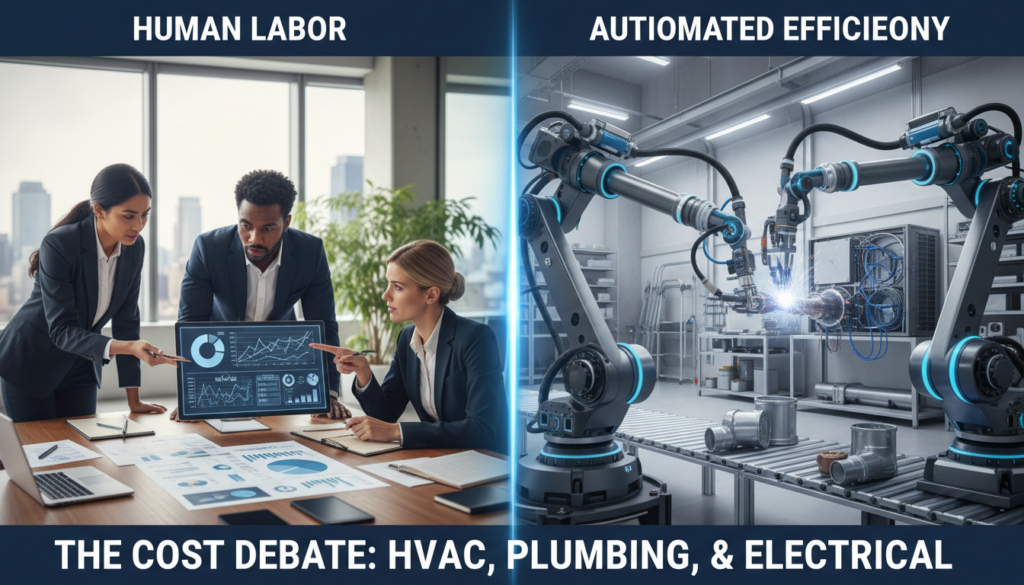
For trade businesses, scheduling and intake are complex. Missed calls mean lost revenue. Many companies now find automation handles these tasks reliably.
These businesses prioritize systems that integrate with field operations. The goal is seamless service delivery from first contact to job completion.
| Aspect | Traditional Hiring | Automation Platforms |
|---|---|---|
| Scalability | Linear, requires more time and resources | Instant, adjusts to demand instantly |
| Upfront Investment | High (recruitment, training) | Moderate (setup, integration) |
| Ongoing Overhead | Significant (benefits, management) | Predictable monthly costs |
| Task Consistency | Varies with human performance | High, operates 24/7 |
Understanding the Full Cost of Hiring Staff
The financial reality of bringing on another team member extends far beyond their monthly paycheck. You must account for all associated expenditures to see the complete picture.
Salary, Benefits, and Onboarding Expenses
The base salary is your most visible line item. Yet, recruitment itself carries a significant upfront financial burden, often between $1,000 and $3,000 per hire.
Immediate added costs include:
- Payroll taxes and workers’ compensation insurance
- Health benefits and paid time off
- The productivity gap during initial training
We calculate the total value of an employee is often 25% higher than their base pay.
Hidden Costs and Long-Term Investments
Traditional hiring requires a long-term commitment. You invest in office space, equipment, and ongoing management for each person.
High industry turnover means the price of replacement can exceed the original investment. Managing manual processes for onboarding adds layers of complexity that distract from core work.
These hidden costs create linear overhead that strains growth. This is the true cost scaling with people. Modern automation platforms are designed to mitigate many of these burdens.
Fundamentals of Automation in Service Industries
Modern automation platforms are not just software; they are a new operational layer for service businesses. They create reliable, scalable systems for your front-office work. This foundation is built on two core components: what the technology delivers and how you implement it.
What Automation Platforms Typically Offer
These platforms provide 24/7 availability. This is essential for HVAC and plumbing businesses receiving after-hours emergency calls.
They handle repetitive intake and scheduling tasks consistently. This frees your team to focus on high-impact customer interactions.
The primary benefit is scalability. Automation platforms can manage increased call volume instantly. They do this without the need for additional staff.
Initial Setup and Integration Challenges
The setup for automation tools often requires a one-time investment. This ensures proper system integration with your existing software.
Integration with CRM and dispatch systems is a common focus. Modern platforms are designed to connect seamlessly, but planning is critical.
A proper setup is key to achieving your desired efficiency gains. It reduces time spent on manual processes and prevents operational bottlenecks.
cost of hiring an office employee vs automation
A direct financial comparison reveals a stark difference in operational spending. You must look at the ledger to understand where your capital delivers the most value.
Direct Monthly and Annual Cost Comparison
A full-time team member commands a significant salary, typically $3,000 to $4,000 per month. This figure excludes benefits, taxes, and equipment.
In contrast, modern automation platforms handle similar administrative functions for $300 to $700 each month. This creates a predictable expense line for your budget.
The annual cost for one employee can easily surpass $50,000. For small businesses, this linear overhead strains growth. Choosing automation can save thousands yearly while ensuring 24/7 service availability.
One employee’s salary often funds multiple digital tools. This reallocation toward scalable solutions is a powerful financial lever.
Comprehensive Cost Breakdown: Humans vs AI Tools
A side-by-side financial analysis reveals the operational leverage of technology over linear human scaling. You must examine both monthly outlays and first-year projections to see the full picture.
Monthly Expense Overview
Your monthly budget faces two different pressures. A full marketing automation stack runs between $1,500 and $4,000 per month.
This replaces several roles with one predictable expense. In contrast, a single employee’s salary is just the start. Benefits, taxes, and management add significant monthly overhead.
| Expense Category | Human Resource | AI Tool |
|---|---|---|
| Monthly Outlay | $3,000 – $6,000+ | $300 – $4,000 |
| Annual Commitment | ~$50,000 – $185,000 | ~$6,000 – $48,000 |
| Scalability Impact | Adds linear cost | Predictable scaling |
First-Year Cost Projections from Multiple Sources
First-year totals are decisive. Traditional hiring for a mid-level professional can reach $185,000.
The first-year cost of hiring a mid-level professional can reach $185,000 when including salary, benefits, and management overhead.
We project the first-year investment in AI automation tools is often $6,000 to $9,000 for small businesses. This stark difference defines the true cost of scaling.
Hidden costs like recruitment time are often overlooked. Automation platforms typically deliver productivity gains that pay for themselves within the first year.
Evaluating ROI and Operational Efficiency
Measuring the payoff of your operational investments requires a clear focus on two metrics: ROI and productivity. You move beyond simple cost comparison to see how each dollar spent creates leverage in your workflow.
Break-Even Analysis and Recovery Rates
A break-even analysis for automation often shows the system pays for itself within the first month. This rapid return is driven by recovering missed revenue from calls that would otherwise go unanswered.
In contrast, traditional hiring involves a longer payback period. The investment in recruitment and training delays positive cash flow. Optimizing manual processes with technology achieves higher recovery rates daily.
Productivity Multipliers and Efficiency Gains
Automation platforms can increase support productivity by a factor of 15x. This gain happens when routine tasks are handled digitally, freeing your team for complex, high-value roles.
Your operational efficiency is directly tied to integration. Businesses using integrated systems for lead intake see a 6x to 10x jump in processing capacity.
| Performance Metric | Human-Centric Approach | Automation-Driven Approach |
|---|---|---|
| Time to Break-Even | Several months to a year | Often within the first month |
| Typical Recovery Rate | Limited by staff hours | High, operates 24/7 |
| Productivity Multiplier | Linear (1x) | Exponential (6x to 15x) |
This scalability enhances growth without the management overhead of adding staff. The roi of automation is clear when you measure output against total costs.
Real-World Case Studies and Financial Scenarios
Concrete examples reveal the tangible financial impact of choosing between human resources and digital solutions. We examine documented scenarios to move beyond theory.
Case Study: Lost Revenue from Missed Calls
One plumbing company implemented an AI receptionist for $499 per month. This technology captured 50% of previously missed after-hours calls.
The recovered value directly increased monthly revenue. This scenario highlights a major hidden cost for service businesses.
ROI Calculator Insights for Small Businesses
Using an ROI calculator, we see that even a 10% gain in efficiency leads to substantial annual profit growth. These tools model the payoff from reallocating resources.
They demonstrate how automating routine roles boosts overall productivity. Your investment in systems pays back quickly.
5-Year Projection Analysis
Over five years, traditional hiring can accumulate to $325,000 in fully loaded expenses. In stark contrast, automation platforms typically range from $30,000 to $45,000 for the same period.
The difference in long-term financial impact is profound. This analysis favors automation for businesses needing to scale support without linear cost growth.
Scalability and Integration Strategies for Automation
True operational growth is not about hiring more staff but about leveraging systems that scale instantly. Your strategy must address both volume handling and workflow cohesion.
Instant Scalability vs. Traditional Hiring
Automation platforms provide instant scalability. They allow your business to handle peak demand without the delays of traditional hiring.
Hiring new staff is a slow, linear process. In contrast, digital tools can be deployed to new departments in a matter of days. This agility is a key competitive advantage.
Integration with Existing Systems
Seamless integration ensures your data remains consistent across all platforms. This maintains high operational standards and supports compliance.
We find that businesses prioritizing integration can scale rapidly while keeping their teams productive. Your human roles then focus on strategic decision-making.
The ROI of these systems is maximized when they are fully woven into daily workflows. This approach improves overall efficiency and sustains growth.
Addressing Hidden Risks and Compliance Considerations
Scaling your business with technology introduces new layers of operational complexity. You must balance efficiency gains with potential pitfalls in customer experience and vendor reliance.
Risks in Over-Automation and Dependency on Vendors
Over-automation can weaken customer relationships if complex issues lack human support. We advise clear protocols for escalating tasks to your team.
Vendor dependency adds another hidden risk. Proactive oversight of your automation platforms ensures they remain aligned with your operational goals.
Compliance, Legal, and Quality Control Factors
Maintaining compliance is streamlined when automation tools follow strict, pre-defined protocols. Regular audits of these systems are essential for quality control.
Hiring for high-touch roles preserves personal client connections. Your investment in both technology and human oversight creates a robust framework that minimizes risk.
Strategic Implementation for Small Business Growth
A smart implementation plan turns automation from a concept into a daily operational advantage. Your focus should be on targeted adoption that strengthens your workflow without disruption.
Identifying High-Impact Areas for Automation Adoption
Start with repetitive, high-volume tasks. Automating FAQ responses, for example, saves significant resources for complex customer issues.
This allocation of effort is critical. We recommend a model of 70% automation and 30% human expertise for early-stage businesses. This balance maximizes efficiency while preserving personal support.
Your team’s productivity soars when routine handling is managed by systems. This frees staff for strategic roles that grow your business.
Managing the Transition and Training Staff
Successful integration requires training your team to work alongside new tools. Frame automation platforms as collaborators, not a replacement for their roles.
This mindset shift is key. It minimizes the risk of workflow disruption and builds internal expertise.
Human oversight ensures compliance and quality control for sensitive interactions. Your investment in both technology and training delivers greater value.
This approach reduces operational costs while improving service quality. It provides a scalable alternative to linear traditional hiring models.
The Hybrid Model: Balancing Human Talent and Automation
Operational excellence in HVAC and plumbing isn’t about choosing between people and platforms; it’s about integrating both. The hybrid model is the most effective way for service businesses to maintain high service quality. You achieve this by blending automation with personal expertise.
When Human Staff Are Essential
Your team is vital for complex negotiations and building long-term client relationships. These high-touch interactions require human judgment and empathy. Automation tools cannot replicate this personal connection.
Best Practices for Combining AI Tools with Personal Service
We suggest using automation platforms for FAQ responses and appointment scheduling. This frees up time for your front-desk team. Human agents should review output to ensure compliance and quality before customer contact.
Optimizing for Customer Experience and Operational Agility
Operational agility comes from the right mix of technology and human skill. Allocating resources to both creates a resilient business model. This approach handles any volume while improving efficiency.
Your productivity soars when routine handling is managed by systems. Staff then focus on strategic roles. The hybrid cost is often lower than traditional hiring, delivering greater value and scalability.
Conclusion
Scaling sustainably requires moving beyond linear cost models to embrace intelligent systems. Your strategic choice between automation and traditional hiring defines your operational future. We have demonstrated that automation platforms deliver superior ROI and scalability for front-office support.
Maintaining a hybrid approach preserves the human touch where it matters most. This balance reduces operational costs while ensuring service quality. Your focus on compliance and control remains paramount as you integrate new tools.
By reducing turnover and managing resources wisely, you build a resilient business model for long-term growth. These sustainable models outperform linear hiring over any year.
Evaluate your specific needs to find the right mix of talent and technology. Begin your transition now to gain a decisive competitive edge. Automation is not a replacement for people; it is the force multiplier that empowers your team.